
Appliance passports, built on the data you already keep
Fridges, washing machines and dishwashers already carry an energy label, spare-parts duties and, in the EU since 31 July 2026, a right to repair. A digital passport under ESPR is expected later, with no date set yet. xProduct keeps energy data, spare parts, repair, documents and end-of-life information in one passport, reached by a code on the appliance.

Rules on this page
- ESPR (EU) 2024/1781
- Energy labelling (EU) 2017/1369 · EPREL
- Right to Repair (EU) 2024/1799
- WEEE 2012/19/EU
- RoHS 2011/65/EU
- Batteries (EU) 2023/1542
- GPSR (EU) 2023/988
- CRA (EU) 2024/2847
- UK SI 2021/745 · SI 2013/3113
31 July 2026: the EU right to repair applies to appliances
Under Directive (EU) 2024/1799, manufacturers of products with EU repair requirements, such as washing machines, washer-dryers, dishwashers and fridges, must offer to repair them after the legal guarantee, at a reasonable price, and say how. When a consumer chooses repair under the legal guarantee, the guarantee is extended by 12 months. Check how your country has written it into national law.
Appliance passport: expected, no date yet
A passport becomes a duty only when the new ecodesign rules for an appliance group say so. None has been adopted for appliances yet.
01/Who it affects
Appliances already carry a lot of rules
Long before a passport is required, appliance makers and importers publish energy data, keep spare parts, take back old appliances and answer for safety. Each rule asks for data a passport can hold.
Large appliances with an energy label
Fridges and freezers, washing machines, washer-dryers, dishwashers, tumble dryers and other labelled appliances.
- Register each model in EPREL before placing it on the EU market
- Ship the A to G label with its QR code, and the product information sheet
- For fridges, dishwashers, washing machines and tumble dryers: keep listed spare parts for 7 to 10 years and deliver them within 15 working days
- For the same appliances: give professional repairers repair and maintenance information
Every electrical appliance
From a kettle to a heat pump: waste, substances and safety rules apply to all of them.
- Register as a producer and fund take-back in each EU country where you sell; mark the crossed-out wheeled bin
- Stay within the RoHS limits and sign an EU declaration of conformity for the CE marking
- Online offers show the manufacturer, the EU responsible person if needed, a picture, an identifier and the warnings
Cordless and connected appliances
Appliances with a built-in battery or a network connection have extra rules, mostly from 2027.
- From 18 February 2027, portable batteries removable and replaceable by the user, with some exceptions
- Since 1 August 2025, cybersecurity rules for appliances with a radio
- Cyber Resilience Act: vulnerability reporting since 11 September 2026, product rules from 11 December 2027
02/How it works
From appliance to passport in seven steps
The same steps for a kettle and a fridge-freezer. Fill them in at your own pace and publish when the passport is complete.
- 01
Choose the appliance category
The category decides which passport sections you can choose from, such as energy label, spare parts, repairability and recyclability.
Home Appliances - 02
Add the appliance
Name, GTIN or model number, pictures and a description, and a product class from 37 home-appliance classes in ECLASS, such as fridges, washing machines, dishwashers, ovens, vacuum cleaners and heat pumps.
GTINECLASSPictures - 03
Enter the energy data
The energy class, annual or per-cycle consumption, noise and other values from the label and product information sheet, and the refrigerant for fridges and heat-pump dryers.
Energy classConsumptionRefrigerant - 04
Add spare parts and repair
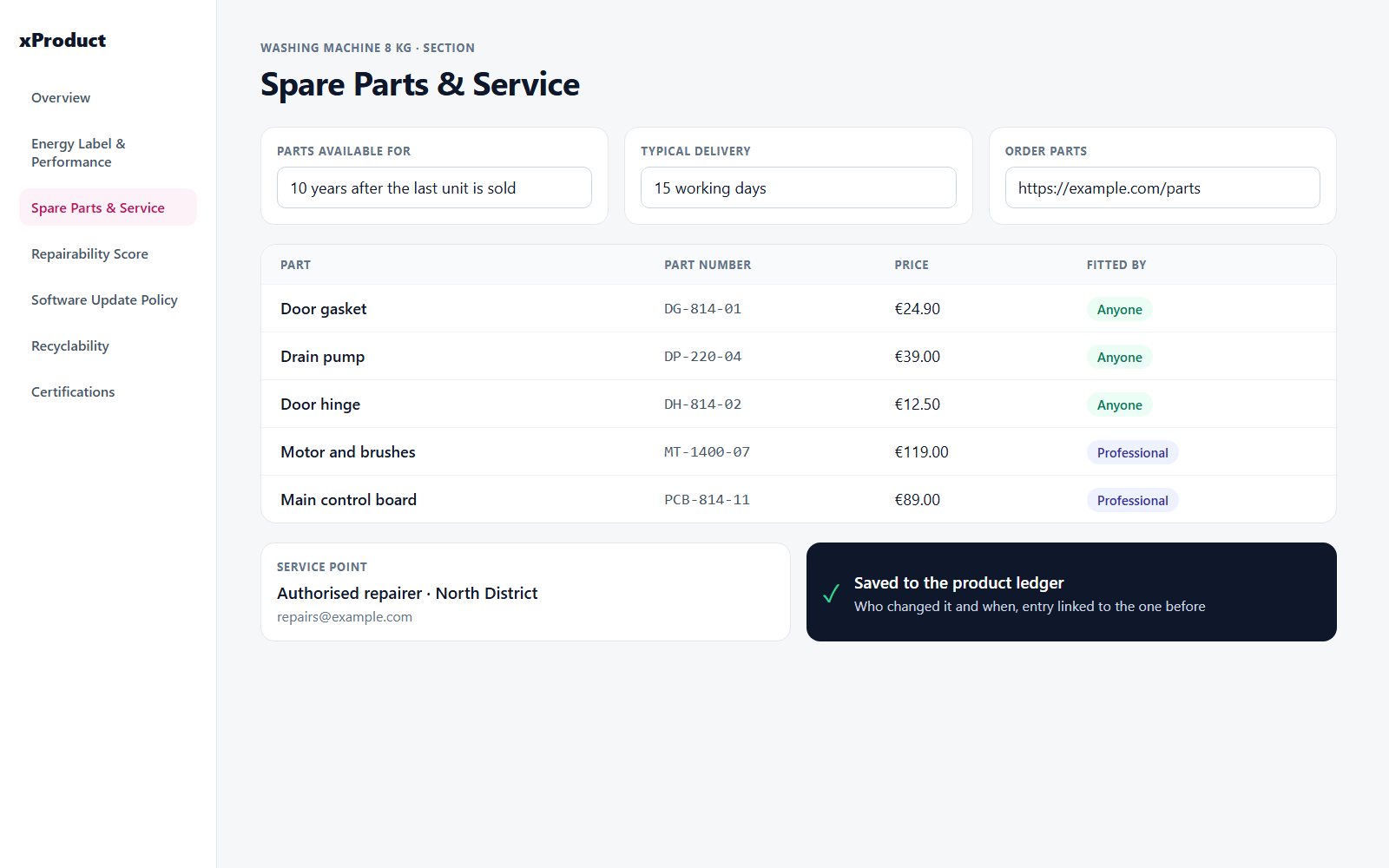
For how many years parts are available, delivery times, how to order, each part with its number and price and whether anyone or only a professional can fit it, and where the appliance can be repaired.
Spare partsRepairService points - 05
Attach documents
Declaration of conformity, test reports, safety information and the user manual, each with its dates. On a paid plan, upload a file and its details are filled in for you to check.
DeclarationsTest reportsManuals - 06
Name the responsible companies
Manufacturer, EU importer or EU responsible person, GB importer. Enter each company once and pick it for every product.
ManufacturerImporter - 07
Publish and put the code on the appliance
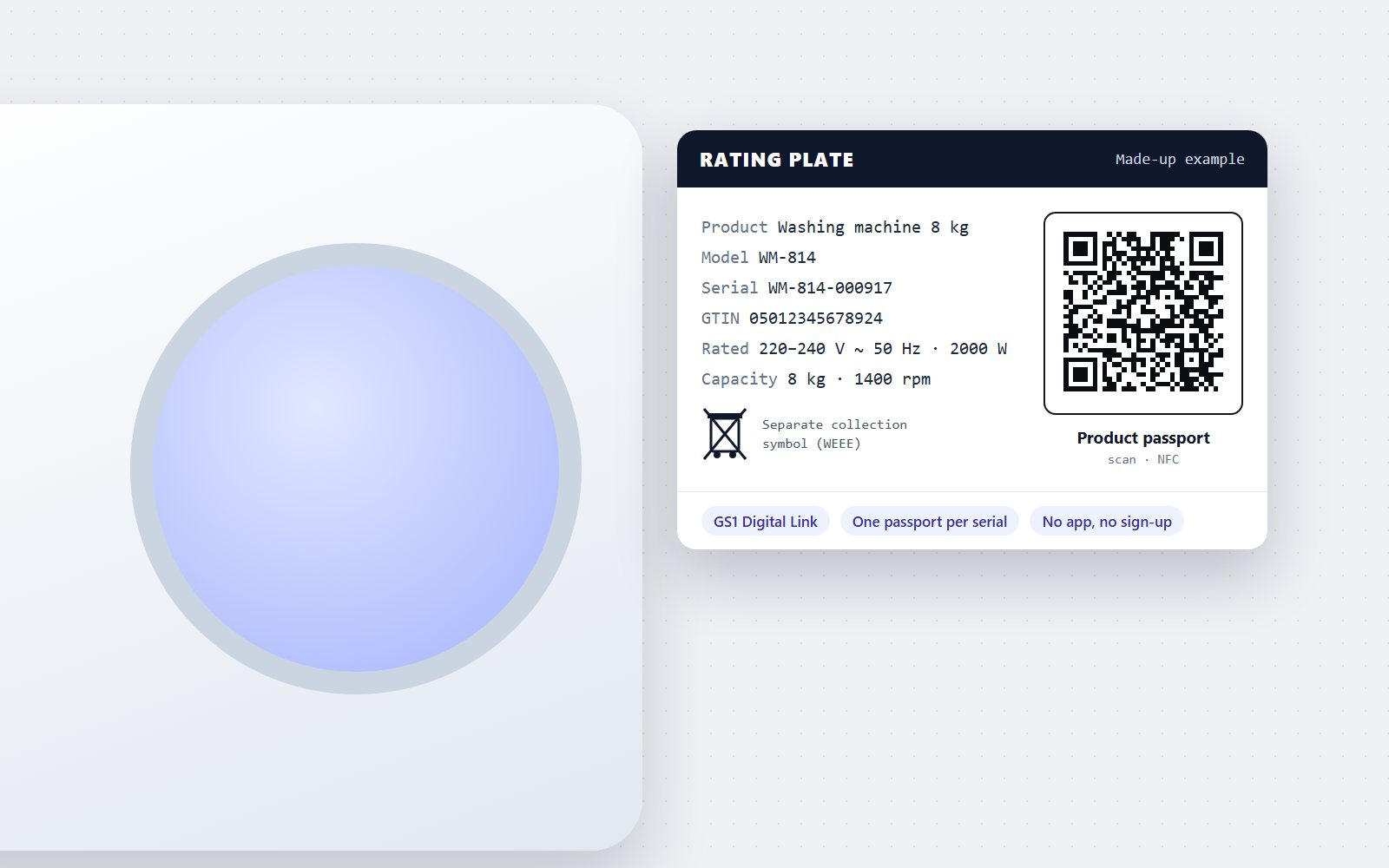
The passport goes live, free to open with no sign-up. Print the QR code next to the rating plate or inside the door, or use an NFC tag or a GS1 Digital Link address.
QRNFCGS1 -
Try it
Build your first appliance passport on the free plan
No card needed. Add one appliance and see the passport a buyer or repairer will see.
03/The law
What the rules ask of appliances
No law requires a digital passport for an appliance yet. The energy label, ecodesign, repair, waste, chemicals and safety rules already apply, and the battery and cyber rules follow in 2027.
A summary of the rules as of November 2026, not legal advice. Dates marked as not set are not fixed in law.
- 01
Ecodesign (ESPR): the passport comes later
The Ecodesign for Sustainable Products Regulation, Regulation (EU) 2024/1781, has been in force since 18 July 2024. The existing ecodesign rules for appliances stay in force until they are replaced under it. The Commission's working plan 2025–2030, adopted on 16 April 2025, keeps the reviews of existing appliance rules and plans rules on repairability, including a repair score, for consumer electronics and small household appliances, and on the recyclability of electrical and electronic equipment. A passport becomes a duty only when the new rules for an appliance group say so; none has been adopted yet. How the passport and EPREL will work together for labelled products is still being decided.
- 02
Energy label and EPREL
Under Regulation (EU) 2017/1369, a supplier registers each model in the EU product database for energy labelling (EPREL) before placing it on the EU market, and ships it with the label and product information sheet. The rescaled A to G labels, with a QR code that leads to the model's EPREL entry, have applied to fridges, dishwashers and washing machines since 1 March 2021, and to tumble dryers since 1 July 2025.
- 03
Ecodesign rules: spare parts and repair information
Since 1 March 2021 (Regulations (EU) 2019/2019, 2019/2022 and 2019/2023), makers of fridges, dishwashers, washing machines and washer-dryers must keep listed spare parts for 7 to 10 years, depending on the appliance and the part, counted from when the last unit of the model is placed on the market, and deliver them within 15 working days. Some parts may be limited to professional repairers, who must also get repair and maintenance information. Tumble dryers have had similar rules since 1 July 2025 (Regulation (EU) 2023/2533).
- 04
Right to repair
Directive (EU) 2024/1799 has applied since 31 July 2026 through national laws. For products with EU repair requirements, such as washing machines, washer-dryers, dishwashers and fridges, the manufacturer must offer repair after the legal guarantee at a reasonable price, tell consumers about it, and not block repairs with second-hand or independent parts without a good reason. If a consumer chooses repair under the legal guarantee, the guarantee is extended by 12 months. Repairers can give consumers a European Repair Information Form with the price and terms.
- 05
Waste (WEEE) and hazardous substances (RoHS)
Under Directive 2012/19/EU, producers register in each EU country where they sell, finance the collection and treatment of old appliances and mark them with the crossed-out wheeled bin. Under Directive 2011/65/EU, appliances must stay within the RoHS limits for lead, mercury, cadmium, hexavalent chromium, certain flame retardants and phthalates, shown in the EU declaration of conformity. REACH adds a duty to pass on information about substances of very high concern above 0.1% by weight.
- 06
Batteries in appliances
From 18 February 2027 (Article 11 of Regulation (EU) 2023/1542), portable batteries built into appliances, such as cordless vacuum cleaners, must be readily removable and replaceable by the end user, with some exceptions. The battery passport of the same regulation is for electric vehicle, light means of transport and larger industrial batteries, not for batteries in small appliances.
- 07
Safety, CE marking and connected appliances
Appliances need CE marking under the Low Voltage and EMC Directives, and the Radio Equipment Directive when they have a radio. Since 1 August 2025, connected radio equipment must meet cybersecurity rules (Delegated Regulation (EU) 2022/30). Under the Cyber Resilience Act, Regulation (EU) 2024/2847, manufacturers of connected products must report actively exploited vulnerabilities since 11 September 2026, and its product rules apply from 11 December 2027. Since 13 December 2024, the GPSR asks every online offer to show the manufacturer, the EU responsible person if needed, a picture, an identifier and the warnings.
- 08
Great Britain and Northern Ireland
Great Britain has its own ecodesign and energy information rules, The Ecodesign for Energy-Related Products and Energy Information Regulations 2021 (SI 2021/745), which include spare parts and repair information for appliances such as dishwashers, washing machines and fridges, and its own WEEE Regulations 2013 (SI 2013/3113). The EU Right to Repair Directive does not apply in Great Britain. The Product Regulation and Metrology Act 2025 lets the government make new product rules, but none for appliance passports has been made. In Northern Ireland, the EU energy label, ecodesign and product safety rules apply.
Also worth knowing: since 27 September 2026 (Directive (EU) 2024/825), generic green claims such as "eco-friendly" need proof, and since 12 August 2026 the Packaging Regulation (EU) 2025/40 applies to the box the appliance comes in.
04/Key dates
The dates that matter for appliances
The dates below are fixed in law. The appliance passport and the repair score are planned, with no date set yet.
- 1 Mar 2021
Rescaled A to G energy labels with a QR code to EPREL, and spare-parts and repair rules, for fridges, dishwashers and washing machines
In force - 13 Dec 2024
GPSR applies: what online listings must show, in the EU and Northern Ireland
In force - 16 Apr 2025
ESPR working plan 2025–2030 adopted: reviews of appliance rules and a repairability measure planned
Adopted - 1 Jul 2025
Tumble dryers: new ecodesign rules and the A to G energy label
In force - 1 Aug 2025
Cybersecurity rules for connected radio equipment apply
In force - 31 Jul 2026
EU right to repair applies through national laws
In force - 12 Aug 2026
Packaging Regulation (PPWR) applies
In force - 11 Sep 2026
Cyber Resilience Act: reporting of actively exploited vulnerabilities starts
In force - 27 Sep 2026
EmpCo applies: generic green claims need proof
In force - 18 Feb 2027
Batteries in appliances must be removable and replaceable by the user, with some exceptions
Fixed date - 11 Dec 2027
Cyber Resilience Act: product rules apply to connected appliances
Fixed date - Not set yet
EU repairability rules, including a repair score, for consumer electronics and small household appliances (expected)
Planned - Not set yet
Appliance passport under ESPR, once the new rules for an appliance group are adopted
Planned
05/What is recorded
What an appliance passport records
How much energy it uses, how long parts are available, how to repair, update and recycle it, and the documents behind it, in one record reached by the code on the appliance.
The EU has not fixed a passport data list for appliances yet. These topics follow today's energy label, ecodesign and repair rules and ESPR's general list of product information. The grey tags are the xProduct passport sections that can hold them.
- 01
Energy
The energy class, annual or per-cycle consumption, noise and other values from the label, use patterns, and the refrigerant of fridges and heat-pump dryers. The EPREL registration itself is made in the EU database, not in xProduct.
Energy Label PerformanceEnergy EfficiencyEnergy Usage Pattern - 02
Spare parts and service
For how many years parts are available, delivery time, how to order, each part with its number, price and who can fit it, and the service points that repair the appliance.
Spare Parts & Service - 03
Repair
A repair score with a score per part, the tools needed and disassembly steps.
Repairability ScoreRepair Tools NeededDisassembly - 04
Durability
Expected lifespan, reliability, maintenance and care.
Durability & LifespanLifespan ReliabilityProduct Care - 05
Software and updates
For connected appliances: which updates it gets, such as security and firmware updates, and until when.
Software Update PolicySoftware Support - 06
Materials
Plastics, metals and electronics with their shares, recycled content and critical raw materials.
Material CompositionRecycled ContentCritical Materials - 07
Battery
For cordless appliances: the battery's identity and label, performance and durability.
Battery identity and labelBattery performanceBattery durability - 08
Documents
The EU declaration of conformity, test reports, safety information and the user manual, each with its dates.
Certifications - 09
End of life
How to return the appliance, where it can be recycled and how its parts are recovered.
RecyclabilityTake-Back ProgramRecycling Centers - 10
Packaging
Packaging levels, materials and weights, recyclability, recycled content and sorting instructions.
Packaging - 11
Warranty and companies
What the warranty covers and for how long, and the manufacturer, importer and EU responsible person.
WarrantyResponsible companiesFactory Map
06/Models and units
One model, many versions, and a code for every appliance
Energy labels and spare parts belong to the model; repairs and warranties belong to one appliance. xProduct handles both around one main product.
Colours, sizes and capacities
Add each colour, size or capacity as a variant of the main product. Each variant has its own passport and code, and shows the documents of the main product, so you attach a declaration once.
Serial numbers when you want them
Give each appliance a serial number with its own passport address and QR code, print sheets of labels, and link units to a production batch on the Manufacturer plan. Useful for warranty, repairs and recalls.
A tag out of sight
Put an NFC tag behind the control panel or inside the door, and a phone held close opens the passport. GS1 Digital Link addresses with your GTIN, and with a serial or batch number, are supported too.
07/Repair and second life
Repairs, warranty and a second life, on record
Invite the partners who repair, take back and recycle your appliances, and keep each appliance's history in one place.
Repair partners and warranty on record
Invite the companies that repair, take back and recycle your appliances; their work is recorded against the appliance.
- Return, repair and recycling partners each get their own access
- A repair names the parts repaired, replaced, removed or installed
- Partners record their work against a product or one appliance's serial number; scanning its QR code fills the number in
- On paid plans, buyers can register their appliance for your warranty from the passport; an electronics policy is ready to adapt: 2 years, plus 12 months after registration
A second life with its own passport
When an appliance is remanufactured or repurposed, it continues on a new passport that points back to the original.
- A remanufactured or repurposed appliance gets its own serial number and passport, linked to the original; the original keeps its history
- Each appliance has a status: Original, Re-used, Repurposed, Remanufactured or Waste
- Take-back, recycling centre and recyclability sections tell the owner what to do with the appliance at the end
08/Why start now
Your buyers and repairers need the data now
Most of the data already exists in your label files, technical documentation and spare-parts lists. A passport puts it where people look: on the appliance.
Repair is now a right in the EU
Since 31 July 2026, consumers in the EU can ask the manufacturer to repair listed appliances after the legal guarantee. A passport tells them how, which parts exist and where the nearest service point is.
Spare-parts duties run for years
Parts must stay available for 7 to 10 years for many large appliances. Keeping the list, the delivery time and the order link in the passport makes that promise easy to find for the whole period.
2027 brings batteries and cyber rules
From 18 February 2027 batteries in cordless appliances must be removable and replaceable by the user, with some exceptions, and from 11 December 2027 connected appliances fall under the Cyber Resilience Act. Battery and software update sections can hold the data.
On the Manufacturer and Enterprise plans, xProduct's green claims check reads your own product texts for generic claims such as "eco-friendly" and says what each kind of claim needs. It is a word list, not a legal check, and nothing from it shows on the public passport.
09/Tamper-evident
Every change recorded. Any change can be checked.
An appliance passport may be read for ten years or more, by buyers, repairers and recyclers. xProduct writes every change to a passport, its values, its documents and its publishing, to the product's ledger, each entry linked to the one before. Every night a fingerprint of the latest entries is written to a public blockchain.
Tamper-evident means a later change can be seen and checked. It does not make the data correct: what the passport says remains the manufacturer's statement.
- Linked entries — change an old entry and the links after it no longer match.
- A public record every night — Documents remain private off-chain. Only cryptographic fingerprints are anchored for integrity checks.
- A signed passport — systems can fetch the passport as a signed copy and check it with the public keys the site publishes; anyone can check it on the seal page. It is not a qualified electronic seal.
- Swapped documents show — a replaced declaration or test report is a new entry, with who changed it and when.
- The passport as it was — see the passport as it was on an earlier date, back to when its version history began.
10/Live example
See a live appliance passport
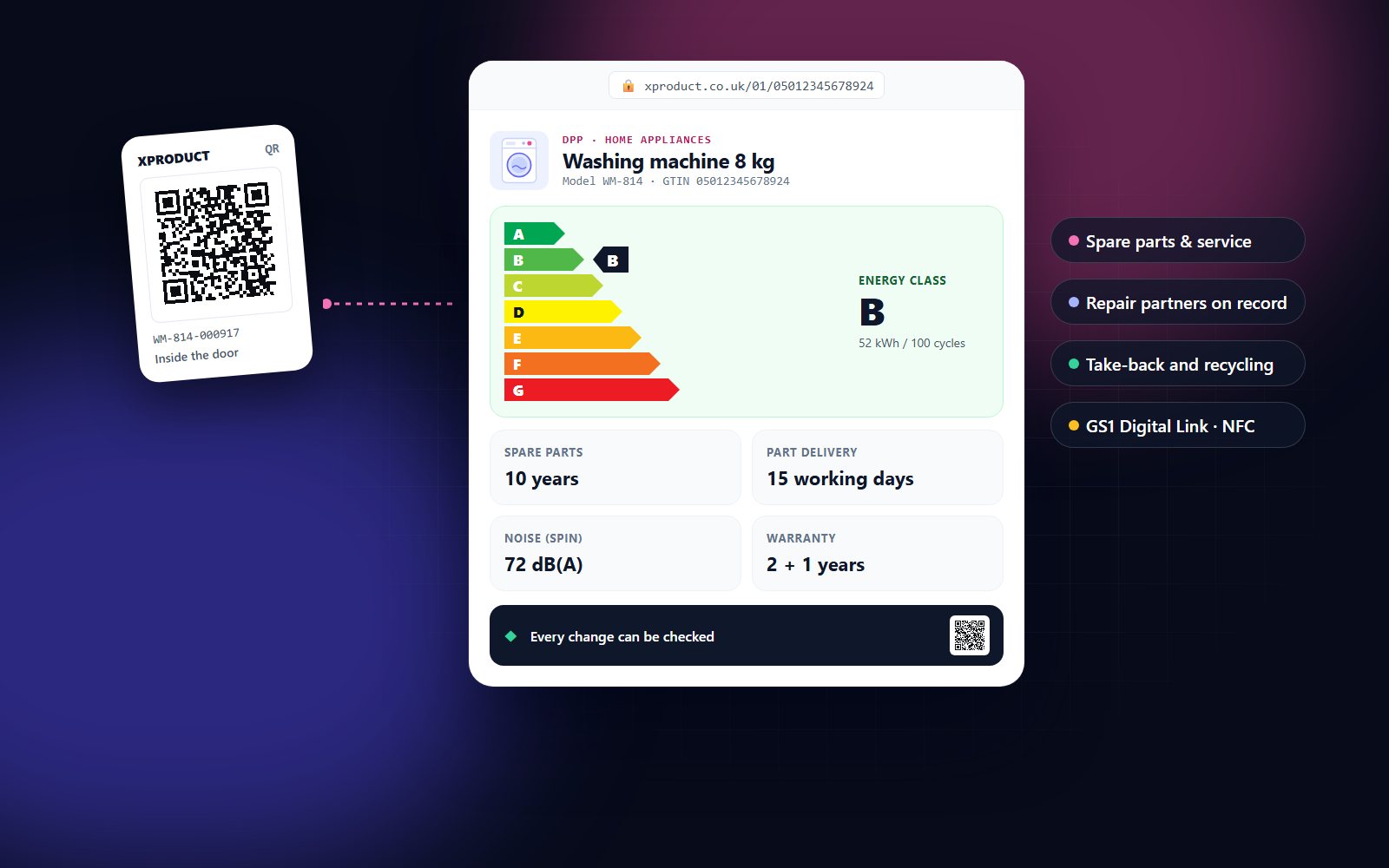
Energy data, spare parts and repair, documents and end-of-life information, as a buyer, a repairer or a recycler sees them after scanning the code on the appliance.
- Energy class, consumption and noise
- Spare parts, how to order them and where to repair
- Declarations, test reports and manuals with their dates
- Change history you can check
11/Questions
Common questions
Is a digital product passport required for appliances today?
No. A passport becomes a duty only when the new ESPR rules for an appliance group require one, and none has been adopted yet. The energy label, EPREL, spare-parts, repair, WEEE, RoHS and safety rules already apply.
Does a passport replace the energy label or EPREL?
No. The label and the EPREL registration stay a legal duty. The passport can repeat the label values next to the spare parts, repair and recycling information, so people find them in one place.
Which appliances can I add?
Any. The ECLASS list has 37 home-appliance classes, such as fridges and freezers, washing machines, tumble dryers, dishwashers, ovens and hobs, coffee machines, vacuum cleaners, air purifiers, air conditioners and heat pumps.
Does xProduct make my appliance meet the rules?
No tool can do that for you. xProduct holds and publishes your data, shows which sections are still empty and keeps a record of every change. What the data says, and whether the appliance meets the rules, remains the manufacturer's responsibility.
Get your appliance data ready, one model at a time
Start with one appliance on the free plan, or book a demo and see an appliance passport built step by step.
A summary of the rules as of November 2026, not legal advice. Dates marked as not set are not fixed in law.