
Electronics passports, for the data the rules already ask for
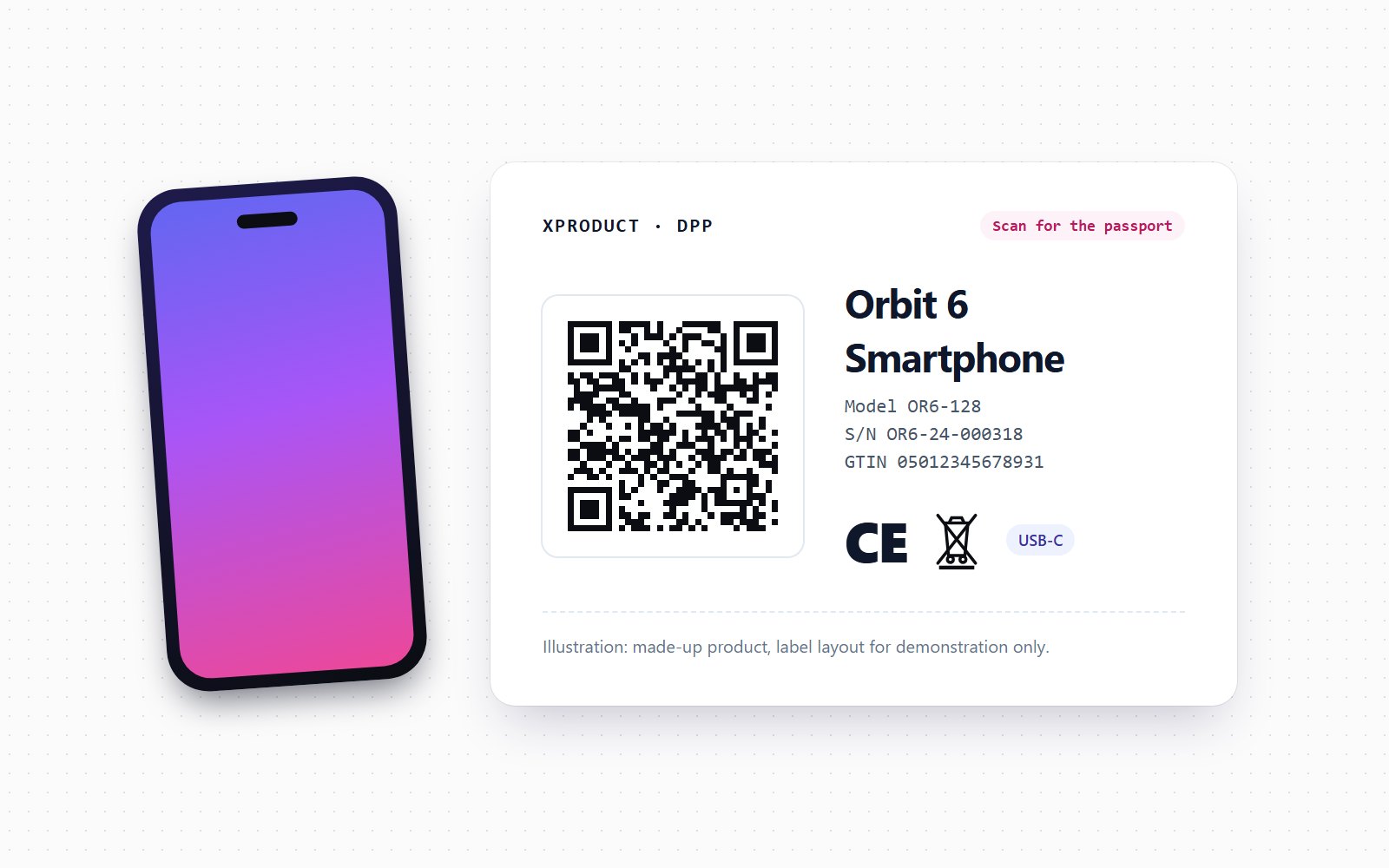
Phones and tablets have carried an energy label with a repairability class since June 2025, the EU repair rules apply from 31 July 2026, and portable batteries in most products must be replaceable by the user from 18 February 2027. A passport for all electronics is not set in law yet. xProduct keeps specifications, energy data, spare parts, repair, software updates and declarations in one passport, reached by a code on the device or its box.
Rules on this page
- ESPR (EU) 2024/1781
- (EU) 2023/1670 · 2023/1669
- Energy label (EU) 2017/1369
- Right to Repair (EU) 2024/1799
- Batteries (EU) 2023/1542
- WEEE 2012/19/EU
- RoHS 2011/65/EU
- GPSR (EU) 2023/988
- UK WEEE · UK RoHS · PSTI
18 February 2027: batteries the user can replace
From this date, a product with a portable battery placed on the EU market must let the end user remove and replace the battery, with commercially available tools, for the product's lifetime. Some products may instead have it replaced by independent professionals; the list of these exceptions is being changed, so check the current text. Replacement batteries must stay available for at least five years after the last unit of a model is placed on the market.
EU repairability rules for electronics expected around 2027
The Commission plans rules on repairability, including a score, around 2027, and on recycled content and recyclability of electronics around 2029. No date for an electronics passport is set in law yet.
01/Who it affects
The rules that already reach electronics
Electronics already carry more product information duties than most goods. Some apply to every device, some to phones and tablets only, and some to devices with a battery or a radio. Each asks for data a passport can hold.
All electrical and electronic equipment
From a USB stick to a television: waste, substance and safety rules apply to every device sold in the EU.
- Producer registration in each EU country where you sell, and the crossed-out wheeled bin on the product
- Ten restricted substances (RoHS), a declaration of conformity and CE marking
- Manufacturer details, product identifier and safety information on every online offer
Phones and tablets
Smartphones and slate tablets have their own ecodesign rules and an energy label with a repairability class.
- Registration in EPREL and a label with energy class, repairability class, battery endurance and IP rating
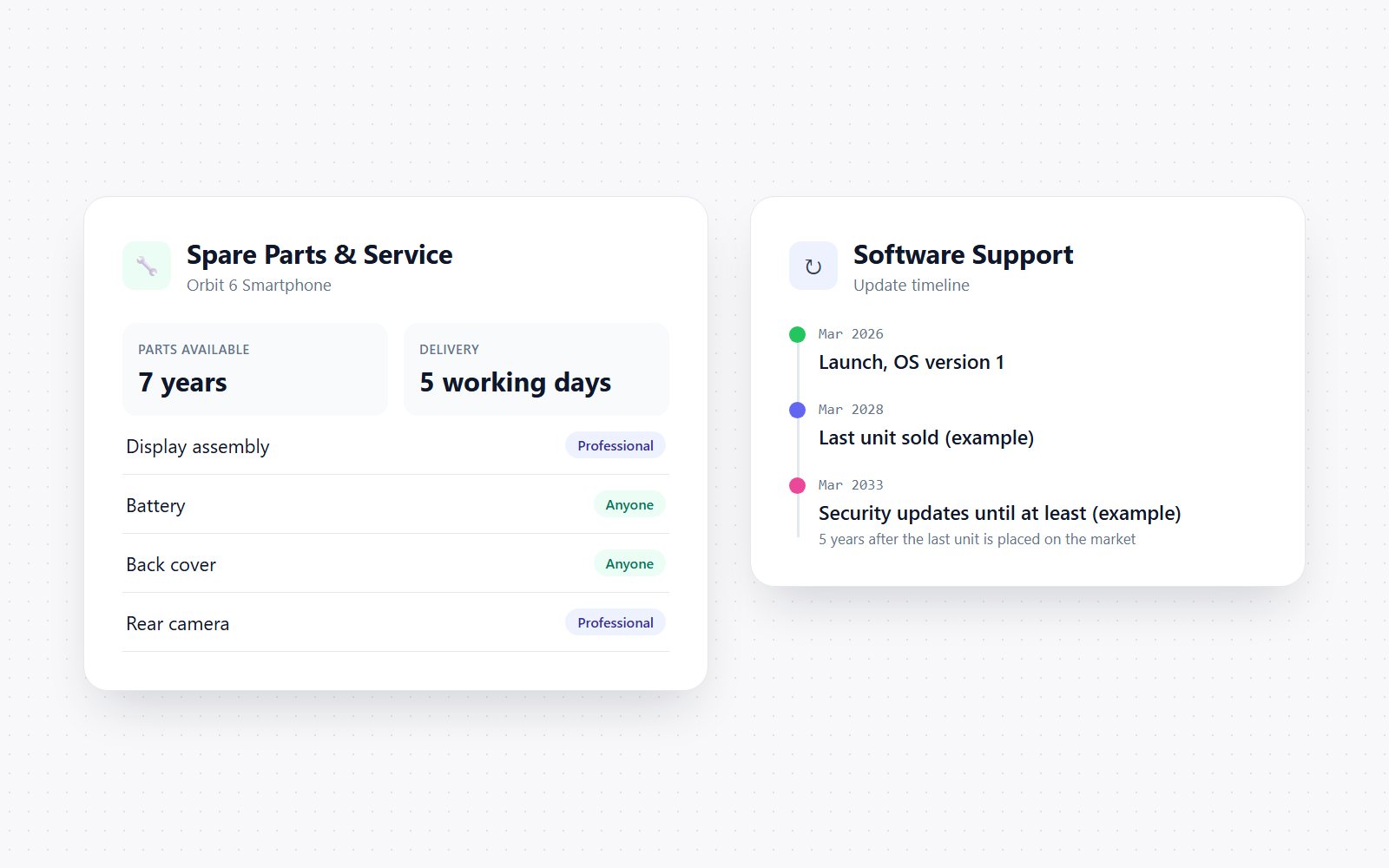
- Spare parts for at least seven years after the model leaves the market
- Operating system updates for at least five years after the last unit is placed on the market
Devices with a battery or a radio
Batteries, charging ports and connected devices bring their own rules.
- Portable batteries the user can replace from 18 February 2027, with exceptions
- A USB-C port on phones, tablets, cameras, headphones and laptops
- Cybersecurity rules for connected radio equipment, and the Cyber Resilience Act from December 2027
02/How it works
From device to passport in seven steps
The same steps for a phone, a monitor or a router. Fill them in at your own pace and publish when the passport is complete.
- 01
Choose the electronics category
The category decides which passport sections you can choose from, such as specifications, energy, spare parts and software support.
Electronics (Phones, Tablets, Laptops) - 02
Add the device
Name, GTIN or model number, pictures and a description, and a product class from 31 electronics classes in ECLASS, such as smartphones, notebooks, monitors, headphones and routers.
GTINECLASSPictures - 03
Record specifications and energy data
Key specifications, the energy class and other label values, and power use in each mode. The registration in the EU energy label database (EPREL) is done there, not in xProduct.
SpecificationsEnergy label - 04
Add spare parts, repair and software
Which parts can be replaced and by whom, for how many years they are available, delivery times, a repairability score, the tools needed and the software update timeline.
Spare partsRepairSoftware - 05
Attach declarations and test reports
The EU declaration of conformity, RoHS and REACH declarations and test reports, each with its dates. On a paid plan, upload a file and its details are filled in for you to check.
DeclarationRoHSTest reports - 06
Name the responsible companies
Manufacturer, EU importer or EU responsible person, GB importer. Enter each company once and pick it for every product.
ManufacturerImporter - 07
Publish and put the code on the device
The passport goes live, free to open with no sign-up. Print the QR code on the box, the rating label or the manual, or use an NFC tag or a GS1 Digital Link address.
QRNFCGS1 -
Try it
Build your first electronics passport on the free plan
No card needed. Add one device and see the passport a buyer will see.
03/The law
What the rules ask of electronics
There is no general electronics passport law yet. The Ecodesign Regulation (ESPR) is expected to bring EU-wide repairability rules first. Meanwhile the rules for phones and tablets, the energy label, repair, waste, substances and product safety already apply.
A summary of the rules as of November 2026, not legal advice. Dates marked as estimates are not set in law.
Read more in the product rules library
- 01
Ecodesign (ESPR): repairability first
The Commission's ESPR working plan 2025–2030, adopted on 16 April 2025, plans rules on repairability, including a repairability score, around 2027, and on recycled content and recyclability of electrical and electronic equipment around 2029; both years are estimates. Ecodesign rules already made for energy-related products, such as displays, external power supplies and standby, stay in force. No date is set for a passport for electronics in general.
- 02
Phones and tablets: ecodesign and energy label
Since 20 June 2025 (Regulations (EU) 2023/1670 and 2023/1669), smartphones and slate tablets carry an energy label with the energy class, a repairability class, battery endurance in cycles and the ingress protection rating. Spare parts must be available for at least seven years after a model leaves the market, operating system updates for at least five years after the last unit is placed on the market, and the battery must keep at least 80% of its capacity after 800 cycles.
- 03
Energy label and EPREL
Under Regulation (EU) 2017/1369, labelled products such as televisions, monitors, phones and tablets must be registered in the EU product database EPREL before they are sold, and the QR code on the label leads to the model's public EPREL page. A passport can show the same values next to repair and software information, but does not replace the label or the registration.
- 04
Right to Repair (EU) 2024/1799
From 31 July 2026 manufacturers of products with EU repairability requirements, such as phones, tablets, displays and household appliances, must offer to repair them, also after the legal guarantee, at a reasonable price, and give access to spare parts at reasonable prices. They may not block the use of second-hand or 3D-printed parts or independent repairers with contract terms, hardware or software. A consumer who chooses repair under the legal guarantee gets the guarantee extended by 12 months. Each EU country makes its own law to apply it.
- 05
Batteries Regulation (EU) 2023/1542
From 18 February 2027 portable batteries in products must be removable and replaceable by the end user, with exceptions that let independent professionals do it for some products. The battery passport, also from 18 February 2027, is for electric vehicle, light means of transport and industrial batteries above 2 kWh, not for the battery inside a phone or laptop.
- 06
Waste (WEEE) and substances (RoHS, REACH)
Under the WEEE Directive 2012/19/EU, producers register in each EU country where they sell, finance collection and recycling, and mark products with the crossed-out wheeled bin. A revision of the WEEE rules is being prepared, with nothing adopted yet. RoHS (Directive 2011/65/EU) limits ten substances in every homogeneous material and needs a declaration of conformity and CE marking. Substances of very high concern above 0.1% by weight must be passed on to customers and notified to the ECHA SCIP database.
- 07
Chargers, radio and cybersecurity
The common charger rules (Directive (EU) 2022/2380) require a USB-C port for phones, tablets, cameras, headphones and similar devices since 28 December 2024, and for laptops since 28 April 2026. Wireless devices connected to the internet have had to meet cybersecurity requirements under the Radio Equipment Directive since 1 August 2025. The Cyber Resilience Act (EU) 2024/2847 requires reporting of actively exploited vulnerabilities from 11 September 2026, and its main rules apply from 11 December 2027.
- 08
Product safety (GPSR) and green claims (EmpCo)
Since 13 December 2024, in the EU and Northern Ireland, every online offer of a consumer product must show the manufacturer's name and addresses, the EU responsible person if the manufacturer is outside the EU, a picture and identifier of the product, and its warnings and safety information. Since 27 September 2026 (Directive (EU) 2024/825), generic claims such as "eco-friendly" need proof of recognised excellent environmental performance.
- 09
Great Britain and Northern Ireland
In Great Britain the WEEE Regulations 2013 apply, with online marketplace duties since 12 August 2025, together with the UK RoHS Regulations 2012. Since 29 April 2024 the product security regime (PSTI) bans universal default passwords on connectable consumer products, asks for a way to report security issues and asks the minimum period of security updates to be published. GB sets its own ecodesign and energy label rules, so EU rules made since 2021, such as the phone and tablet rules, do not apply in GB unless GB adopts them. Northern Ireland follows the EU product rules.
Not for electronics yet: the EU ban on destroying unsold products, which has applied to large companies since 19 July 2026, covers only clothing, clothing accessories and footwear.
04/Key dates
Electronics rules, date by date
Dates marked Estimate are not set in law: they come from the Commission's ESPR working plan. The other dates are fixed.
- 13 Dec 2024
GPSR applies: what online listings must show, in the EU and Northern Ireland
In force - 28 Dec 2024
USB-C charging port required for phones, tablets, cameras, headphones and similar devices
In force - 16 Apr 2025
ESPR working plan 2025–2030 adopted: repairability and electronics recyclability rules planned
Adopted - 20 Jun 2025
Ecodesign rules and energy label with repairability class for smartphones and tablets
In force - 1 Aug 2025
Cybersecurity requirements for internet-connected radio equipment (Radio Equipment Directive)
In force - 28 Apr 2026
USB-C charging port required for laptops
In force - 31 Jul 2026
Right to Repair rules apply through national laws: repair offers, spare parts, 12 more months of legal guarantee after a repair
In force - 11 Sep 2026
Cyber Resilience Act: actively exploited vulnerabilities and serious incidents must be reported
In force - 27 Sep 2026
EmpCo applies: generic green claims need proof
In force - 18 Feb 2027
Portable batteries in products must be removable and replaceable by the end user, with exceptions
Fixed date - 2027
ESPR repairability rules, including a repairability score, expected to be adopted
Estimate - 11 Dec 2027
Cyber Resilience Act main rules apply to products with digital elements
Fixed date - 2029
ESPR rules on recycled content and recyclability of electronics expected to be adopted
Estimate - Not set yet
A passport for electronics in general under ESPR, and the revised EU WEEE rules
05/What is recorded
What an electronics passport records
What the device can do, how much energy it uses, how to repair it and for how long it gets updates, in one record reached by the code on the device or its box.
The EU has not fixed a passport data list for electronics. These topics follow the phone and tablet rules, the energy label, the repair rules and ESPR's general list of product information. The grey tags are the xProduct passport sections that can hold them.
- 01
Specifications
Standardised specifications for product listings and transparency at the point of sale.
Key specificationsElectronics Comparison - 02
Energy
The energy class and other label values, and power use in each mode, such as on, standby and off. The EPREL registration itself is done in the EU database.
Energy Label & PerformanceEnergy efficiency - 03
Spare parts and repair
Which parts can be replaced and whether anyone or only a professional can fit them, for how many years they are available, delivery times, service points, a repairability score by part and the tools needed.
Spare Parts & ServiceRepairability scoreRepair Tools NeededDisassembly - 04
Software and updates
An update timeline with dates, and the update policy: how long operating system and security updates are provided.
Software supportSoftware Update Policy - 05
Battery
The battery sections built for the Batteries Regulation can also describe the battery in a device: chemistry, capacity, expected lifetime and cycles.
Battery Identity & LabelBattery Performance & Durability - 06
Materials and substances
Materials and their shares, critical raw materials such as cobalt or rare earths, recycled content, and RoHS and REACH information.
Material compositionCritical materialsRecycled ContentRegulatory Compliance - 07
Declarations and certificates
The EU declaration of conformity, RoHS and REACH declarations, test reports and certificates, each with its validity dates.
Certifications - 08
Take-back and end of life
How to return the device, where it can be recycled and which parts can be recycled.
Take-Back ProgramRecycling CentersRecyclability - 09
Packaging
Packaging levels, materials and weights, recyclability, recycled content and sorting instructions.
Packaging - 10
Warranty and responsible companies
What the warranty covers and for how long, with an electronics starter policy ready to adapt, and the manufacturer, importers and EU responsible person.
WarrantyResponsible companies
06/Variants and units
One model, many versions, and a code for every device
Electronics come in colours, memory sizes and regional versions, and each device may need its own history for warranty and repair. xProduct handles both around one main product.
Colours, memory sizes and versions
Add each colour, memory size or version as a variant of the main product. Each variant has its own passport and code, and shows the documents of the main product, so you attach a declaration once.
Serial numbers when you want them
Give each device a serial number with its own passport address and QR code, print sheets of labels, and link devices to a production batch on the Manufacturer plan. Useful for warranty, repairs and returns.
On the box, the label or a tag
Print the QR code on the box, the rating label or the manual, or use an NFC tag that opens the passport when a phone is held close. GS1 Digital Link addresses with your GTIN, and with a serial or batch number, are supported too.
07/Repair and second life
Repairs, updates and refurbished devices, on record
The repair rules make repair the normal path for many devices. Show buyers and repairers which parts exist and for how long, invite the partners who repair, take back and recycle your devices, and keep each device's history in one place.
Repair partners on record
Invite the companies that repair, take back and recycle your devices; their work is recorded against the device.
- Return, repair and recycling partners each get their own access
- A repair names the parts repaired, replaced, removed or installed
- Partners record their work against a product or one device's serial number; scanning its QR code fills the number in
- An electronics warranty policy is ready to adapt: 24 months, plus 12 months when the buyer registers within 60 days
A refurbished device with its own passport
When a device is refurbished or remanufactured, it continues on a new passport that points back to the original.
- A remanufactured or repurposed device gets its own serial number and passport, linked to the original; the original keeps its history
- Each device has a status: Original, Re-used, Repurposed, Remanufactured or Waste
- Take-back, recycling centre and recyclability sections tell the owner what to do with the device at the end
08/Why start now
The data is already asked for, in many places
Energy values go to EPREL, repair information to buyers and repairers, declarations to importers and inspectors. Keeping them in one passport per model saves the same question being answered many times.
Repair is a duty now
Since 31 July 2026, manufacturers of phones, tablets, displays and other listed products must offer repair after the legal guarantee and give access to spare parts. A passport shows which parts exist, who can fit them and for how long they are available.
Batteries change in 2027
From 18 February 2027 users must be able to replace portable batteries in most products. Replacement steps, the tools needed and how to order a battery are the kind of information a passport can carry.
Software support is part of the product
Phones and tablets must get operating system updates for at least five years after the last unit is placed on the market, and in Great Britain the minimum security update period of connectable products must be published. A software timeline in the passport keeps these dates in one place.
On the Manufacturer and Enterprise plans, xProduct's green claims check reads your own product texts for generic claims such as "eco-friendly" and says what each kind of claim needs. It is a word list, not a legal check, and nothing from it shows on the public passport.
09/Tamper-evident
Every change recorded. Any change can be checked.
Spare part years, update periods and declarations change over a device's life, and people need to see what changed. xProduct writes every change to a passport, its values, its documents and its publishing, to the product's ledger, each entry linked to the one before. Every night a fingerprint of the latest entries is written to a public blockchain.
Tamper-evident means a later change can be seen and checked. It does not make the data correct: what the passport says remains the manufacturer's statement.
- Linked entries — change an old entry and the links after it no longer match.
- A public record every night — only fingerprints go on chain; documents and values stay in xProduct.
- Signed data — each public passport links to its seal check and a signed copy that anyone can check with the public keys the site publishes.
- Swapped documents show — a replaced declaration or test report is a new entry, with who changed it and when.
- The passport as it was — see the passport as it was on an earlier date, back to when its version history began.
10/Live example
See a live electronics passport
Specifications and energy data, spare parts and repair, software support, declarations and test reports, as a buyer, a repairer or a recycler sees them after scanning the code.
- Specifications and energy label data
- Spare parts, repair and software updates
- Declarations and test reports with their dates
- Change history you can check
Get your electronics data ready, one model at a time
Start with one device on the free plan, or book a demo and see an electronics passport built step by step.
A summary of the rules as of November 2026, not legal advice. Dates marked as estimates are not set in law.