
Construction product passports, built on the declarations you already make
The new Construction Products Regulation (EU) 2024/3110 has applied since 8 January 2026 and sets up a digital passport for construction products. Its details come in a delegated act that is not adopted yet. xProduct keeps declared performance, the declaration of performance, certificates, embodied carbon, materials and end-of-life information in one passport, reached by a code on the product, the pack or the pallet label.

Rules and standards on this page
- CPR (EU) 2024/3110
- CPR (EU) No 305/2011
- DPP Registry (EU) 2026/1778
- REACH (EC) 1907/2006
- PPWR (EU) 2025/40
- EmpCo (EU) 2024/825
- EN 15804
- GB CPR 2011 · CE / UKCA
8 January 2026: the new Construction Products Regulation applies
Regulation (EU) 2024/3110 replaces the 2011 regulation step by step. Product families move to the new rules, with one declaration of performance and conformity (DoPC), as their new technical specifications are published; until then the declaration of performance under the old harmonised standards stays in use.
Construction passport: not before mid-2028
The delegated act that sets the passport's details is expected in 2027. Manufacturers then have 18 months. No date is set in law yet.
01/Who it affects
What already applies, and what is coming
Declarations and CE marking already apply to construction products under a harmonised standard. The passport follows once its delegated act is adopted, and the substances, packaging and green claims rules apply to every product.
Products under a harmonised standard
Construction products covered by a harmonised standard, or with a European technical assessment, need a declaration and the CE marking before they are placed on the EU market.
- Today, for most product families: the declaration of performance under the old harmonised standards
- Under the new rules: one declaration of performance and conformity (DoPC)
- Instructions and safety information with the product
The construction product passport
Set up by the CPR; a delegated act, not adopted yet, will set its details.
- Expected to hold the DoPC, product information, instructions and safety information, and technical documentation
- Reached through a data carrier, free of charge
- Due 18 months after the delegated act enters into force
Every construction product
Substances, packaging and green claims rules apply whatever the product family.
- Substances of very high concern above 0.1% by weight: tell your customers and notify the ECHA SCIP database
- Packaging rules (PPWR) since 12 August 2026, transport packaging included
- No generic claims such as "eco-friendly" to consumers without proof
02/How it works
From product type to passport in seven steps
The same steps for an insulation board, a bag of mortar or a steel beam. Fill them in at your own pace and publish when the passport is complete.
- 01
Choose the construction category
The category decides which passport sections you can choose from, such as specifications, embodied carbon, materials and end of life.
InsulationCementSteel - 02
Add the product
Name, GTIN or model number, pictures and a description, and a product class from 42 construction classes in ECLASS, such as mineral wool, cement, concrete, bricks, windows, plasterboard and cross-laminated timber.
GTINECLASSPictures - 03
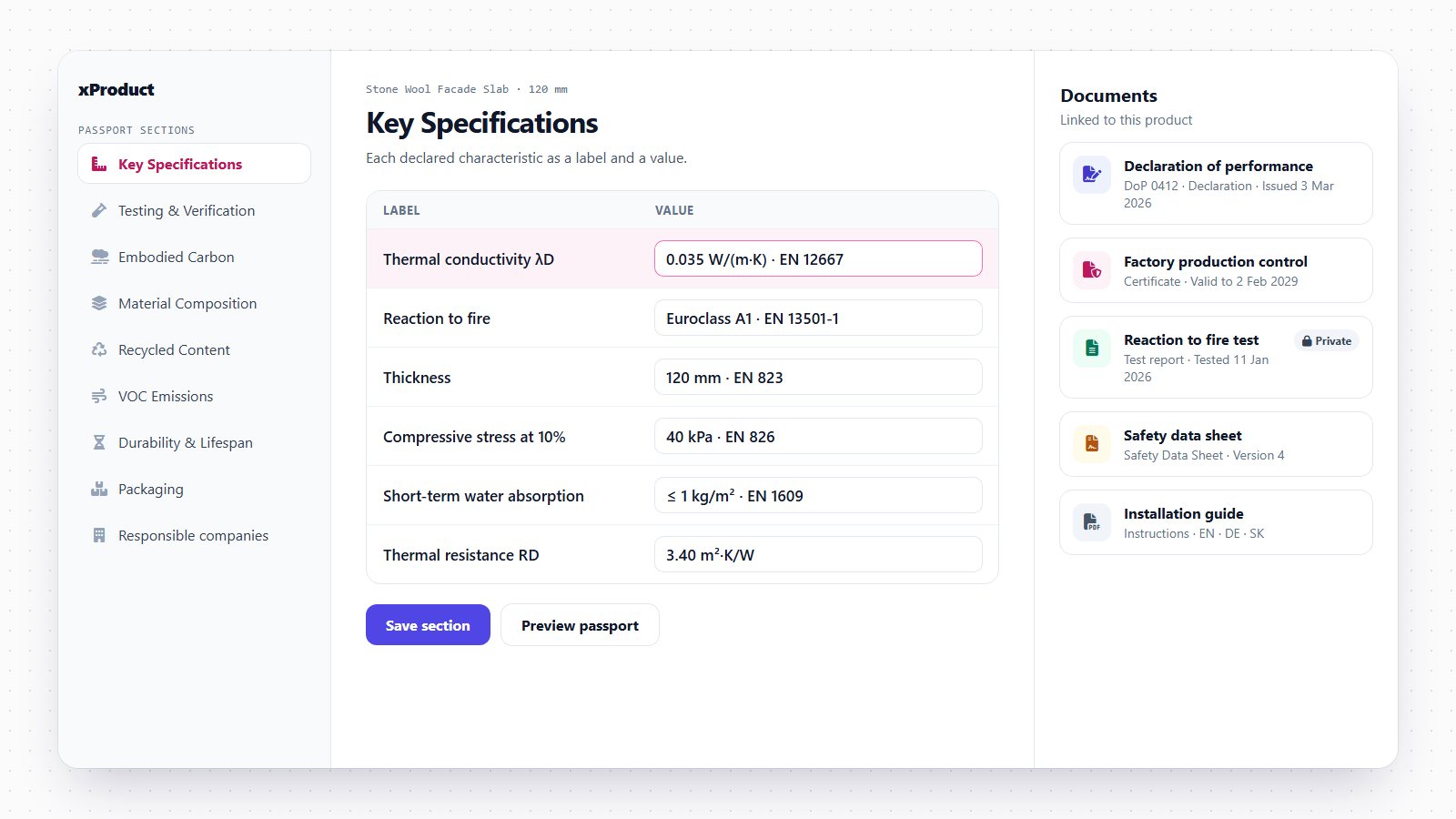
Record the declared performance
The essential characteristics you declare, such as thermal conductivity, reaction to fire or compressive strength, each as a label and a value, for example "0.035 W/(m·K), EN 12667".
SpecificationsTests - 04
Attach the declaration and certificates
Your declaration of performance (later the DoPC), certificates, test reports and safety data sheets, each with its dates. On a paid plan, upload a file and its details are filled in for you to check.
DoPCertificatesTest reports - 05
Add carbon and materials
Embodied carbon for stages A1–A3, for example from your EPD, materials and their shares, and recycled content.
A1–A3EPDRecycled content - 06
Name the responsible companies
Manufacturer, EU importer or authorised representative, GB importer. Enter each company once and pick it for every product.
ManufacturerImporter - 07
Publish and put the code on the product
The passport goes live, free to open with no sign-up. Print the QR code on the product, the pack or the pallet label, or use an NFC tag or a GS1 Digital Link address.
QRNFCGS1 -
Try it
Build your first construction passport on the free plan
No card needed. Add one product and see the passport a contractor will see.
03/The law
What the rules ask of construction products
The Construction Products Regulation sets the declaration, the CE marking and the passport. Substances, packaging and green claims have their own rules, and Great Britain has its own regime.
A summary of the rules as of November 2026, not legal advice. Dates marked as estimates are not set in law.
- 01
Construction Products Regulation (EU) 2024/3110
Adopted on 27 November 2024, in force since 7 January 2025 and applied since 8 January 2026. It replaces Regulation (EU) No 305/2011 step by step: a product family moves to the new rules when its new harmonised technical specifications apply, and the old rules can keep applying during a transition that ends on 8 January 2040 at the latest.
- 02
Declaration of performance and conformity, CE marking
Under the new rules the manufacturer draws up one declaration of performance and conformity (DoPC) and affixes the CE marking. Products still under a harmonised standard of the old regulation keep the declaration of performance (DoP) until their family moves over. Instructions and safety information go with the product.
- 03
The construction product passport
The CPR sets up a digital product passport system for construction products, meant to work like the ESPR passport. It is expected to hold the DoPC, product information, instructions and safety information and technical documentation, reached free of charge through a data carrier. A delegated act will set the details; as of November 2026 it has not been adopted. Manufacturers must make the passport available within 18 months of that act entering into force, and it is expected to apply product family by product family.
- 04
Environmental data in the declaration
The new CPR brings environmental characteristics into the declaration. Where a product family's new technical specification asks for it, the global warming potential over the life cycle is declared first, and more indicators are planned for later years. An environmental product declaration (EPD) to EN 15804 is a common source for these values.
- 05
EU Digital Product Passport Registry
Implementing Regulation (EU) 2026/1778 sets up the Registry: an index of passport identifiers, not a store of passport content. It covers construction products as well as ESPR products, batteries, toys and detergents.
- 06
REACH and SCIP: substances of very high concern
A product that contains a substance of very high concern above 0.1% by weight must come with enough information for safe use, passed on to customers (REACH), and be notified to the ECHA SCIP database (Waste Framework Directive).
- 07
Packaging (PPWR)
Regulation (EU) 2025/40 has applied since 12 August 2026 to all packaging, including transport packaging such as pallet wrap, bags and pallets. Further requirements, such as recyclability and labelling, follow in later years.
- 08
Green claims to consumers (EmpCo)
Since 27 September 2026 (Directive (EU) 2024/825), generic claims such as "eco-friendly" in offers to consumers, for example in DIY stores, need proof of recognised excellent environmental performance, and sustainability labels must come from a certification scheme or a public authority. Claim the specific fact instead, such as the declared GWP per m².
- 09
Great Britain and Northern Ireland
In Great Britain the Construction Products Regulation 2011, as it applies in GB, still applies; CE marking is accepted with no end date set, and UKCA marking can be used instead. The Construction Products Reform White Paper (February 2026) proposes a national construction products regulator and a general safety requirement; the consultation closed on 20 May 2026. The White Paper proposes that information on every product be available digitally, through a unique identifier and a digital label such as a QR code, and that GB stays aligned with EU passports where that fits. Nothing is in law yet. In Northern Ireland the EU construction products rules apply.
Not under ESPR: construction products get their passport through the CPR, not the Ecodesign Regulation. ESPR's working plan of 16 April 2025 does name iron and steel, and aluminium, as priority intermediate products; their rules and dates are not set yet. What a Digital Product Passport is
04/Key dates
The road to the construction passport
Dates marked Estimate are not set in law: the year of the passport act is the Commission's indicative plan, and the passport follows 18 months after the act. The other dates are fixed.
- 7 Jan 2025
The new Construction Products Regulation (EU) 2024/3110 enters into force
In force - 16 Apr 2025
ESPR working plan 2025–2030: iron and steel, and aluminium, named as priority intermediate products
Published - 8 Jan 2026
The new CPR applies; product families move over from the 2011 regulation as their new technical specifications apply
In force - Feb 2026
GB Construction Products Reform White Paper published; its consultation closed on 20 May 2026
Published - 12 Aug 2026
Packaging and Packaging Waste Regulation (PPWR) applies
In force - 27 Sep 2026
EmpCo applies: generic green claims to consumers need proof
In force - 2027
Delegated act for the construction product passport expected (Commission's indicative plan)
Estimate - Mid-2028 or later
Construction passport expected to apply, 18 months after its delegated act enters into force, product family by product family
Estimate - 8 Jan 2040
Latest end of the transition from the 2011 regulation
Fixed date
05/What is recorded
What a construction passport records
What the product does, what you declared, what it is made of and how to install, maintain and recover it, in one record reached by the code on the product.
The EU has not fixed the construction passport data list yet. These topics follow what the CPR says the passport will hold, plus what contractors and specifiers ask for today. The grey tags are the xProduct passport sections and document types that can hold them.
- 01
Product identity
GTIN or model number, the product type, a product class from 42 construction classes in ECLASS, pictures and the manufacturer.
Product basics - 02
Declared performance
The essential characteristics you declare, such as thermal conductivity, reaction to fire, compressive strength or dimensions, each as a label and a value with its unit and test standard written in. The test reports behind them can be described in Testing & Verification.
Key SpecificationsTesting & Verification - 03
The declaration
The declaration of performance you issue today, and later the DoPC, attached as a declaration document with its dates. A replaced version stays in the change history.
Declaration (document)Regulatory Compliance - 04
Certificates and test reports
Certificates and test reports, each with its validity dates. Mark a document private and only the authorities you let in see it.
CertificationsTest report (document) - 05
Embodied carbon
Embodied carbon for stages A1–A3 in kg CO₂e, split by stage, and a carbon footprint section, for example with the values from your EPD to EN 15804. The values are yours: xProduct shows them, it does not make an EPD.
Embodied CarbonCarbon Footprint - 06
Materials and recycled content
Materials and their shares, recycled content, and where the materials come from.
Material CompositionRecycled ContentMaterial Sourcing - 07
Substances and indoor emissions
Substances of very high concern, VOC emission results with their test method, and the safety data sheet.
VOC EmissionsSafety data sheet (document) - 08
Installation, use and safety
Installation instructions and safety information, attached as documents.
Instructions (document) - 09
Service life and end of life
Expected working life and maintenance, how to take the product out of a building, and how to reuse or recycle it.
Durability & LifespanDisassemblyRecyclabilityTake-Back Program - 10
Packaging
Packaging levels from the bag to the pallet, materials and weights, recyclability, recycled content and sorting instructions.
Packaging - 11
Responsible companies and plants
Manufacturer, EU importer or authorised representative, GB importer, and the plants where the product is made.
Responsible companiesFactory Map
06/Batches and labels
One product type, many batches, a code on every pallet
Construction products are declared per product type and made in batches. xProduct keeps one passport for the type and lets you trace batches and units around it.
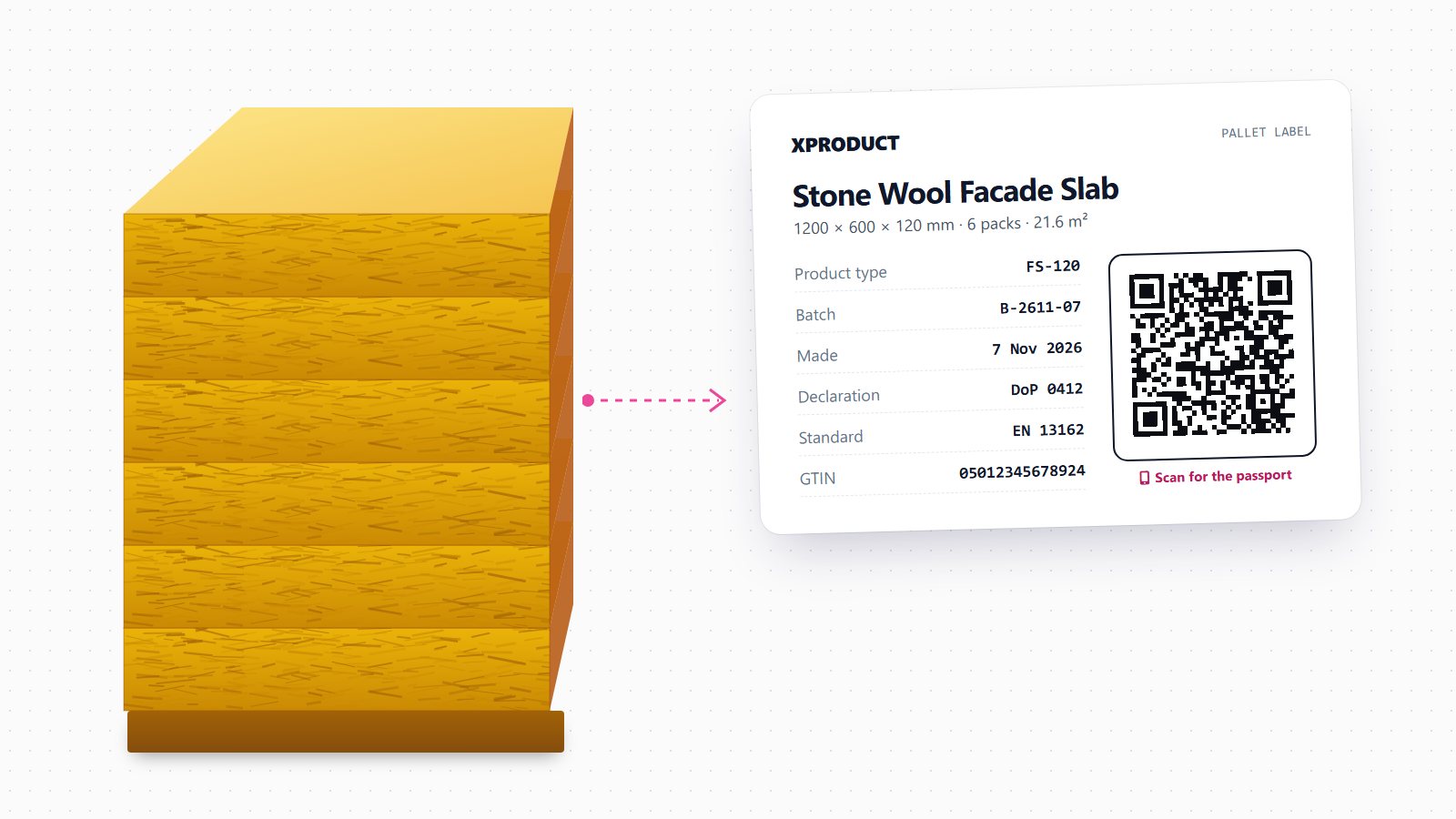
Batch, factory and date
On the Manufacturer plan, record production batches with their steps, and link units to the batch they came from.
Print or export the codes
Print sheets of QR labels, or export a CSV of serial numbers and passport links for your label printer, for products that need their own number, such as windows or doors.
The data carrier you choose
A QR code, an NFC tag, or a GS1 Digital Link address with your GTIN, and with a batch or serial number. The passport opens in a browser, free and with no app.
07/Who sees what
Public data for buyers, more for professionals and authorities
A contractor needs the declared performance; an inspector may need the test reports behind it. Every passport has three levels of access.
Public
Everyone, free and with no sign-up
The sections you publish, such as declared performance, embodied carbon, materials and end of life, and the documents you make public.
Professional
Your repair, return and recycling partners and approved sellers
Everything public, plus the lifecycle events you record for professionals.
Authority
Market surveillance, customs and auditors you let in
Everything, including documents you mark private. An authority can ask for access from a public passport; you decide, and an approved access link lasts 14 days.
The passport act is expected to say which data must be public. Until then, you choose what each level sees.
08/Why start now
Most of the data already exists, in different places
Declarations, test reports, EPDs and data sheets are usually spread over folders and websites. Putting them in one passport now saves the rush later.
Your declarations are ready today
Each declaration of performance, certificate and test report you already have can go into the passport now, with its dates, and be replaced by the DoPC when your product family moves to the new rules.
Carbon data takes time
The global warming potential is the first environmental value the new declaration asks for. Life-cycle data comes from suppliers, plants and EPD studies, and collecting it takes months.
Other rules ask for the same record
Packaging rules (since 12 August 2026), substances of very high concern and green claims to consumers (since 27 September 2026) all ask for data a passport can hold.
On the Manufacturer and Enterprise plans, xProduct's green claims check reads your own product texts for generic claims such as "eco-friendly" and says what each kind of claim needs. It is a word list, not a legal check, and nothing from it shows on the public passport.
09/Tamper-evident
Every change recorded. Any change can be checked.
A building stands for decades, and its products' data may be read long after they were installed. xProduct writes every change to a passport, its values, its documents and its publishing, to the product's ledger, each entry linked to the one before. Every night a fingerprint of the latest entries is written to a public blockchain.
Tamper-evident means a later change can be seen and checked. It does not make the data correct: what the passport says remains the manufacturer's declaration.
- Linked entries — change an old entry and the links after it no longer match.
- A public record every night — documents stay private, off the chain; only fingerprints are written to it.
- Signed data — systems can fetch the passport as a signed copy and check it with the public keys the site publishes. A first step towards a seal, not a qualified electronic seal.
- Swapped documents show — a replaced declaration, certificate or test report is a new entry, with who changed it and when.
- The passport as it was — see the passport as it was on an earlier date, back to when its version history began.
10/Live example
See a live construction passport
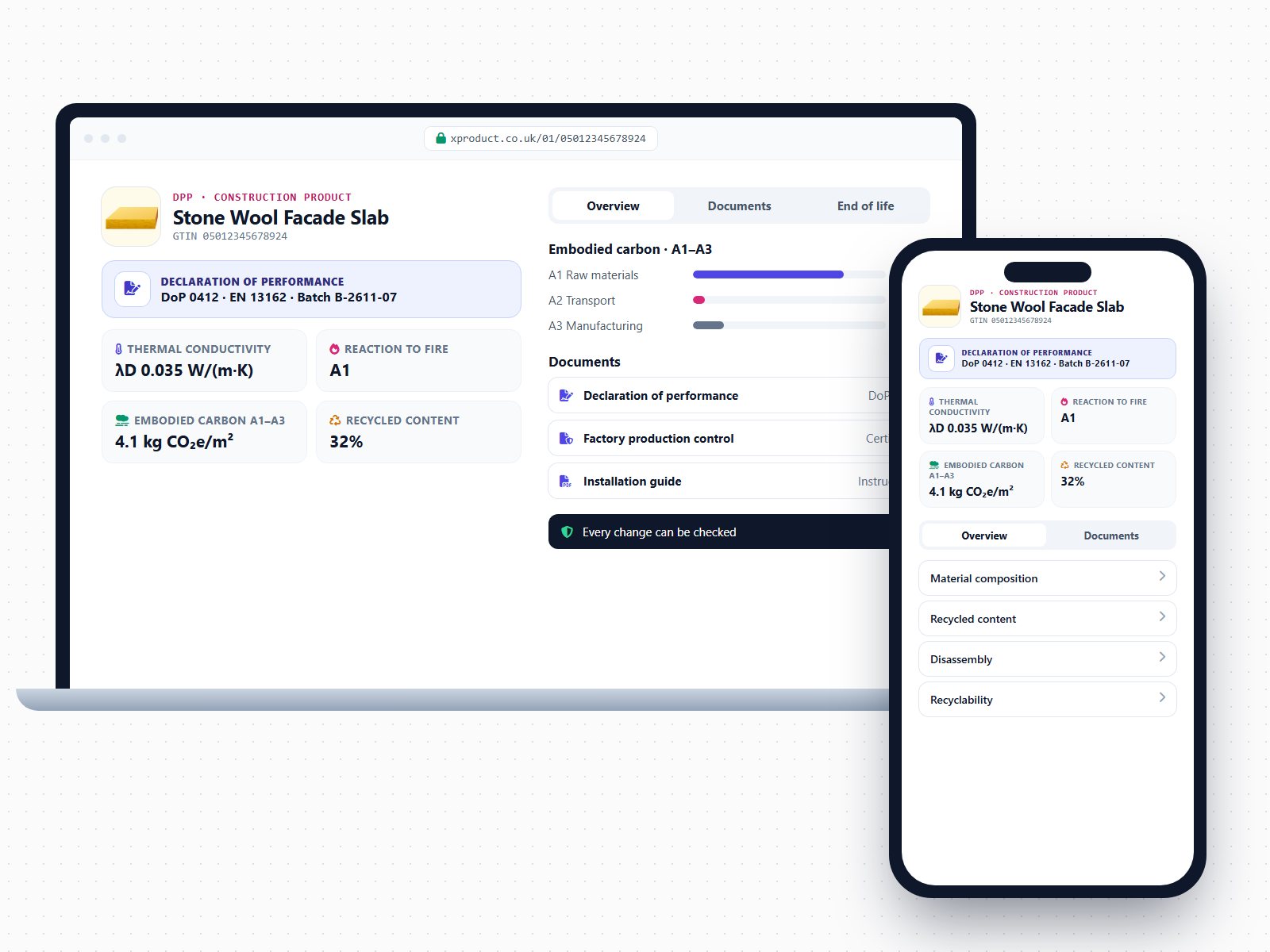
Declared performance, the declaration and certificates, materials and carbon data, as a contractor, a building inspector or a recycler sees them after scanning the code.
- Declared performance with units and test standards
- The declaration, certificates and test reports with their dates
- Materials, recycled content and embodied carbon
- Change history you can check
Get your construction data ready, one product type at a time
Start with one product on the free plan, or book a demo and see a construction passport built step by step.
A summary of the rules as of November 2026, not legal advice. Dates marked as estimates are not set in law.